As I mentioned a couple of weeks ago, our neighbor stopped by with a generous gift of a freshly shot hare from his most recent hunting venture out in the vineyards. A very red, very bloody, very fresh hare that he had kindly "cleaned" (removed fur, chopped off head and cleaned out insides) before bringing to our house.
After getting over the initial shock of all that blood, I managed to cut it into pieces without hurling (and all the while mumbling to myself that this damn thing better be worth it).
I'm really far too squeamish to cut apart animals. The last time I was given a wild boar's leg and had to scrape the bristles off of it and cut the meat off the bone, I almost passed out.
Anyway...
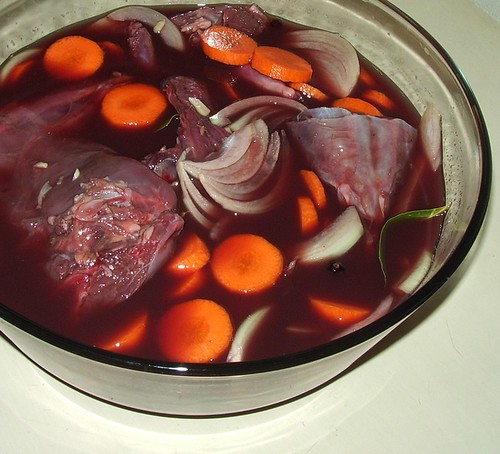 in the marinade
There were several Civet de Lièvre recipes online so I ended up taking bits and pieces from a few and melding them into my own. The result was really fantastic! Very rich and robust, with wonderful, earthy flavors from all the wild thyme and rosemary it had nibbled on out in the garrigue. We loved it!
I hope he brings us another one soon. It was so delicious that I will do my best to ignore all that blood. It really was worth it.
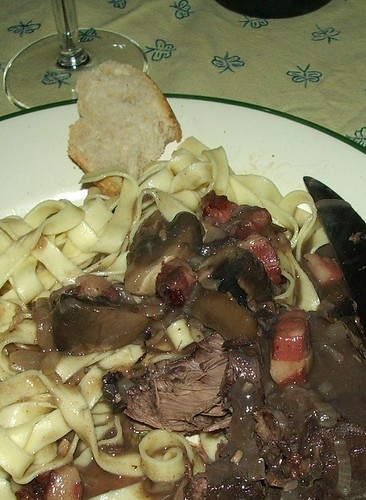 rustic!
Civet de Lièvre
serves 6
2.5 pounds hare, cut into 6-8 portions
The marinade:
1/2-1 bottle (enough to cover the hare) hearty, full-bodied red wine I used a Minervois.
2 tablespoons Armagnac or Cognac
1 large onion, thinly sliced
2 carrots, peeled and sliced into rounds
5 juniper berries
2 bay leaves
2 cloves garlic, minced
~~~~~~~~~~~~~~
2 tablespoons butter or duck fat
6 ounces thick cut, smoked bacon (lardons)
1 large onion, thinly sliced
1 garlic clove, minced
1/4 cup flour
8 ounces button mushrooms, wiped clean and quartered
salt and freshly ground black pepper
Mix the wine and next 6 ingredients and marinate the hare in a big glass bowl, covered, for 24 hours in the fridge, turning the pieces a few times.
The next day, remove the hare from the marinade and pat dry.
Put the reserved marinade in a pan and bring to a boil, then lower the heat and simmer for 30 minutes. Strain the marinade through a fine sieve, pressing down on the solids with the back of a spoon.
While the marinade is simmering, warm the butter or duck fat in a cast iron pot with a lid over medium heat and brown the hare on both sides. Remove to a plate.
Add the lardons to the pot and sauté until lightly browned. Remove to the plate with the hare.
Add the onions to the pot and sauté until just turning a pale golden color, then add the garlic and flour and sauté another minute.
Put the hare pieces, lardons and strained marinade in the pot and bring to a boil. Turn the heat down, cover and simmer for 2 hours.
Add the mushrooms and cook an additional 30 minutes until the hare is tender and falling off the bone.
Season to taste with salt and freshly ground black pepper.
Serve with fresh pasta or potatoes.
If the sauce seems too thin, make a slurry of 1 tablespoon flour dissolved in 2 tablespoons ice water and whisk into simmering sauce. Simmer at least 15 minutes more to allow the sauce to thicken.



 We walked back home to exercise a bit, the evening was perfect. We passed by this beautiful shop on Avenue Mozart and I could not resist taking a picture of the table to share it with you. Coral inspired! The tablecloth is printed with sea shells, the mats imitate a coral reef, the plates have a deep coral rim and a coral decoration in the center ... the total inspiration atunes with the sea theme. I love it!
 Note this: Parents have not abandoned our pigeon.
  I was afraid it would be a pigeon coming just for the food I had put (a mix og yolk, flour, and grains, as I read in a discussion forum). But as I monitored the visitor ... I realized it was always the same. It comes only once and for a short moment (you cannot belive, but I have moved my computer to the living room as to monitor what happens) and the baby screams as soon as it sees the adult, then the adult comes and feeds it putting food in its mouth ... I saw baby pigeon helping himself to my mixture, but only once.
 Today, we got them for the regular price, 21 Euros ($30), i.e 7 Euros per dozen. Here they are in the plastic bag with some seaweed. Note that typically when you buy oysters in Paris, the dozen has 13 pieces, 12 to serve and one, free, for the person who opens them!
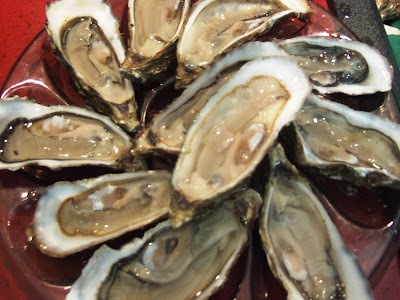 We eat one dozen each and place them in special plastic plates that you put on top of the regular plate, that have 9 spaces with the shape of an oyster.
  It takes some talent to open them (but the seller can do it for you if you ask ahead of time). My husband is very good at that and although he insists in teaching me .. guess, I'm never available to learn! Every Christmas I buy for him the best available knife! The one he prefers is a
 Do you surrender?
 >> Alfajores de Minas, a pastry made of two soft round cookies filled with Dulde de Leche (close to caramel) and coated with white icing. In the picture, a young attendant at the Alfajores Serranos factory, near Minas, invites me to help myslef to an alfajor.
  >> Garrapinada, peanuts coated with melted sugar and more, and sold in small packages in the streets of Montevideo by specialized peddlers.
 >> Asado de Tira, a unique butcher stripe like cut made on the flank of the cow which is barbecued the uruguyyan way.
